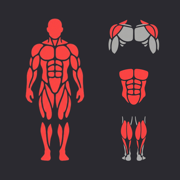
Bodyweight exercises for beginners by movement pattern
The best bodyweight exercises for beginners cover five movement patterns — squat, hinge, push, pull, and core — to organize a balanced session. Pick one move per pattern, do 2–3 rounds, and you've got a complete no equipment home workout in under 20 minutes. Master these before adding load or complexity.
Bodyweight exercises for beginners, organized by movement pattern
Most beginner routines fail for one reason: they're a random grab-bag of moves, three exercises for the chest and none for the back. A movement-pattern approach fixes that — cover squat, hinge, push, pull, and core in one session and the whole body trains in balance, nothing overused, nothing skipped.
Squat pattern: bodyweight squat and split squat
The bodyweight squat is the anchor move for the lower body. Stand with feet shoulder-width apart, push your hips back and bend your knees as if sitting into a chair, keep your chest up, and drive through your heels to stand. Depth matters more than speed — aim for thighs parallel to the floor before chasing reps.
Once a plain squat feels easy for 15–20 reps, move to a split squat (rear foot flat or elevated on a step) or a reverse lunge. Both add a single-leg balance demand a two-footed squat can't.
Hinge pattern: glute bridge and single-leg RDL reach
The hinge is the most commonly skipped pattern in home workouts because it doesn't feel like exercise the way squats and push-ups do — yet it trains the glutes and hamstrings, muscles that contribute to hip extension and trunk control. Start with the glute bridge: lie on your back, knees bent, feet flat, and squeeze your glutes to lift your hips until your body forms a straight line from shoulders to knees.
Progress to a single-leg glute bridge, then a single-leg RDL reach: stand on one leg, hinge forward at the hips while your free leg extends behind you, and touch (or reach toward) the floor before returning to standing. It's a balance challenge as much as a strength one at first — that's normal.
Push pattern: incline push-up to full push-up
Push-ups are the classic bodyweight exercise — they load chest, shoulders, and triceps at once and scale cleanly. Beginners should start with an incline push-up: hands on a sturdy table, counter, or step, body in a straight line, lowering your chest toward your hands and pressing back up.
As that feels manageable for 3 sets of 10–12, lower the incline, then switch to a kneeling or floor push-up. The full push-up is the end of this progression, not the start — there's no shame in spending several weeks on an incline.
Pull pattern: the hardest one to load without equipment
Rows and pull-ups require a secure object to pull against. Floor drills can train the shoulder blades and rear shoulders, but they do not replace loaded pulling. What you can do at home is train the muscles around the shoulder blades that support posture and pulling mechanics later. Prone Y-T-W raises — lying face-down and lifting your arms into a Y, then a T, then a W shape — and reverse snow angels both work the mid-back and rear shoulders without any gear.
If you have a sturdy table or a low bar, a towel or bodyweight row (feet on the floor, body angled back, pulling your chest toward the table edge) is a loaded pulling exercise and worth adding the moment you have access to one.
Core pattern: dead bug and plank variations
The dead bug is the most underrated core exercise for beginners because it teaches you to brace your midsection without arching your lower back — a skill most other core work assumes you already have. Lie on your back, arms reaching toward the ceiling, knees bent at 90 degrees, then slowly extend one arm and the opposite leg toward the floor while keeping your low back flat, and return.
Pair it with a front plank (forearms and toes, straight line from head to heels, hold 20–30 seconds to start) and a side plank for the obliques. Quality beats duration — a shaky 45-second plank teaches worse habits than a clean 20-second one.
Beginner bodyweight workout comparison by movement pattern
| Movement pattern | Beginner move | Starting volume | Progression |
|---|---|---|---|
| Squat | Bodyweight squat | 3 x 12–15 | Split squat or reverse lunge |
| Hinge | Glute bridge | 3 x 12–15 | Single-leg glute bridge, then single-leg RDL reach |
| Push | Incline push-up | 3 x 10–12 | Lower incline, then kneeling or full push-up |
| Shoulder-blade accessory | Prone Y-T-W raise | 2 x 8 per shape | Add a securely anchored row when available |
| Core | Dead bug | 3 x 8 per side | Front plank, then side plank |
How to sequence a first beginner bodyweight workout
Order matters less than consistency, but a sensible default is squat, hinge, push, pull, core — that spreads the work across the body instead of hammering the same muscles back-to-back. Do one exercise per pattern, rest 30–45 seconds between sets, and run the whole circuit two to three times. That's a complete starting workout in 20–25 minutes, no equipment required beyond a chair or step for the incline push-up.
Warm up first — 3–5 minutes of easy marching, arm circles, and a few slow bodyweight squats gets your joints ready without tiring you out. If you're new to structuring rest periods, how long to rest between sets has more detail than "just wing it," and running the five patterns back-to-back with short rest is really a form of circuit training worth exploring as you get fitter.
If you'd rather not watch a clock through a multi-round circuit, Workout Timer is an interval timer and workout tracker for iPhone and Apple Watch with Tabata, HIIT, EMOM/AMRAP-style custom, Strength, Bodyweight and Core templates, plus session history — set your work and rest intervals once and let it run the circuit while you focus on form instead of the clock.

Two or three full-body sessions per week is a practical start. Non-consecutive days simplify recovery, but lighter skill practice can fit elsewhere if soreness and technique are well managed. Once you can complete three full circuits with good form and reps in reserve, that's your signal to progress — a harder variation per pattern, not more total exercises.
FAQ
What are the best bodyweight exercises for beginners?
A squat, a hinge (glute bridge), a push-up variation, a pulling drill like the prone Y-T-W raise, and a core move like the dead bug or plank cover every major movement pattern. Use these as a simple starting framework, then add a securely anchored row when available.
Can you build muscle with bodyweight exercises alone?
Yes, especially as a beginner — your body isn't yet adapted to resistance, so bodyweight moves provide enough of a stimulus to build strength and some muscle. Progress comes from harder variations, like incline push-up to full push-up, rather than added weight, since you're limited by leverage instead of load.
How many days a week should a beginner do bodyweight workouts?
Three non-consecutive days a week — for example Monday, Wednesday, Friday — is a solid starting frequency. That schedule gives a simple recovery day between sessions while you build movement skill.
Do bodyweight exercises really work with no equipment at all?
For squat, hinge, push, and core patterns, yes — bodyweight alone is enough to build a real base of strength. The pull pattern is the exception: true rowing and pulling strength eventually needs something to pull against, so a table edge, sturdy chair, or low bar helps once bodyweight-only pulling drills feel easy.
How long should a first bodyweight workout be?
Plan on 20–25 minutes for two to three rounds through the five movement patterns, plus a short warm-up. That's enough volume to see progress without the session becoming a time commitment you dread on a busy day.
Free VO2 Max Trainer tools
- Calisthenics Workout PlannerGenerate balanced push, pull, leg and core sessions with no equipment-heavy exercise list or signup.
- Cooper 12-Minute VO2 Max CalculatorEnter the distance you covered in 12 minutes. The calculator applies the Cooper field-test equation and shows an estimated VO2 max, average speed, and pace.
- Interval TimerRun work and rest rounds from your browser. Start from a Tabata, HIIT, EMOM, boxing or circuit preset, or set the prep, work, rest and round count yourself.
- Kettlebell Workout PlannerGet two to five balanced sessions using four movements and a time-scaled number of rounds.