
The Norwegian 4x4 method: how to pace it by heart rate
The Norwegian 4x4 method is four minutes of hard running or cycling at 85–95% of max heart rate, followed by three minutes of easy active recovery, repeated four times. It's built to hold you at a high percentage of VO2 max for longer than shorter interval formats manage.
What Is the Norwegian 4x4 Method?
Four work intervals, four minutes each, at 85–95% of max heart rate. Between them, three minutes of easy active recovery — walking, easy jogging, or light spinning, not a dead stop. That's the whole structure, and it's where the name comes from: 4x4. Sixteen minutes of hard work inside a session that runs 35–45 minutes with warm-up and cooldown.
What separates it from shorter interval formats like Tabata or 30-second repeats is duration. Four minutes is long enough for your heart rate to climb into the 90%+ zone and actually hold there — that sustained time near max heart rate is the physiological trigger for VO2 max adaptation. Short intervals can still raise oxygen uptake when repeated with brief recovery, but a single 20-second effort is too short for heart rate to reflect the full metabolic demand.
Where the Norwegian 4x4 Protocol Comes From
The protocol was developed and tested by exercise physiologists Jan Helgerud and Ulrik Wisløff at the Norwegian University of Science and Technology (NTNU) in Trondheim, starting in the early 2000s. Studies have adapted the structure to different populations under different levels of supervision. That does not make an unsupervised hard-interval session appropriate for everyone; people with cardiovascular symptoms or medical restrictions should follow their clinician's exercise guidance.
Pacing the Work Intervals by Heart Rate or Effort
Heart rate is the most reliable way to pace the work intervals: aim for 85–95% of max heart rate, and try to be in the upper half of that range by the third and fourth minute of each interval. A rough estimate of max heart rate is 220 minus your age, but that formula can be off by 10–15 beats for plenty of people . A properly conducted maximal test gives a better anchor, but an unsupervised all-out test is not necessary for using the workout.
If you're not running with a heart rate monitor, effort works almost as well once you know what to feel for. On the Borg 6–20 scale, work intervals should sit around 16–18 — hard to very hard. As a talk test: you should be able to get out three or four words, not a full sentence. If you can hold a conversation through the whole four minutes, you're not deep enough into the 4x4 interval training zone yet — push the pace.
Pacing the Recovery Intervals
The three-minute recovery is active, not a stop. Walk, jog slowly, or spin at low resistance — enough movement to keep blood flowing and start clearing the last interval's fatigue rather than pooling it. Effort here sits around 50–70% of max heart rate, roughly RPE 9–12 on the Borg scale.
The recovery interval isn't meant to fully reset you. Its job is to drop your heart rate just enough that you can drive it back up into the 85–95% zone for the next four minutes, without letting it fall so far you're starting each round cold. If you are still unable to control breathing when the next interval starts, the preceding work may have been too hard or the recovery too demanding. Recovery should remain easy; do not turn it into another work interval.
Running a Full Norwegian 4x4 Session
A complete session: 10 minutes of easy warm-up, building through a few short pickups to get your heart rate moving before the first interval starts. Then four rounds of four minutes hard, three minutes easy — 28 minutes of work and recovery back to back. Finish with 5 minutes of easy cooldown. That's roughly 40–45 minutes door to door.
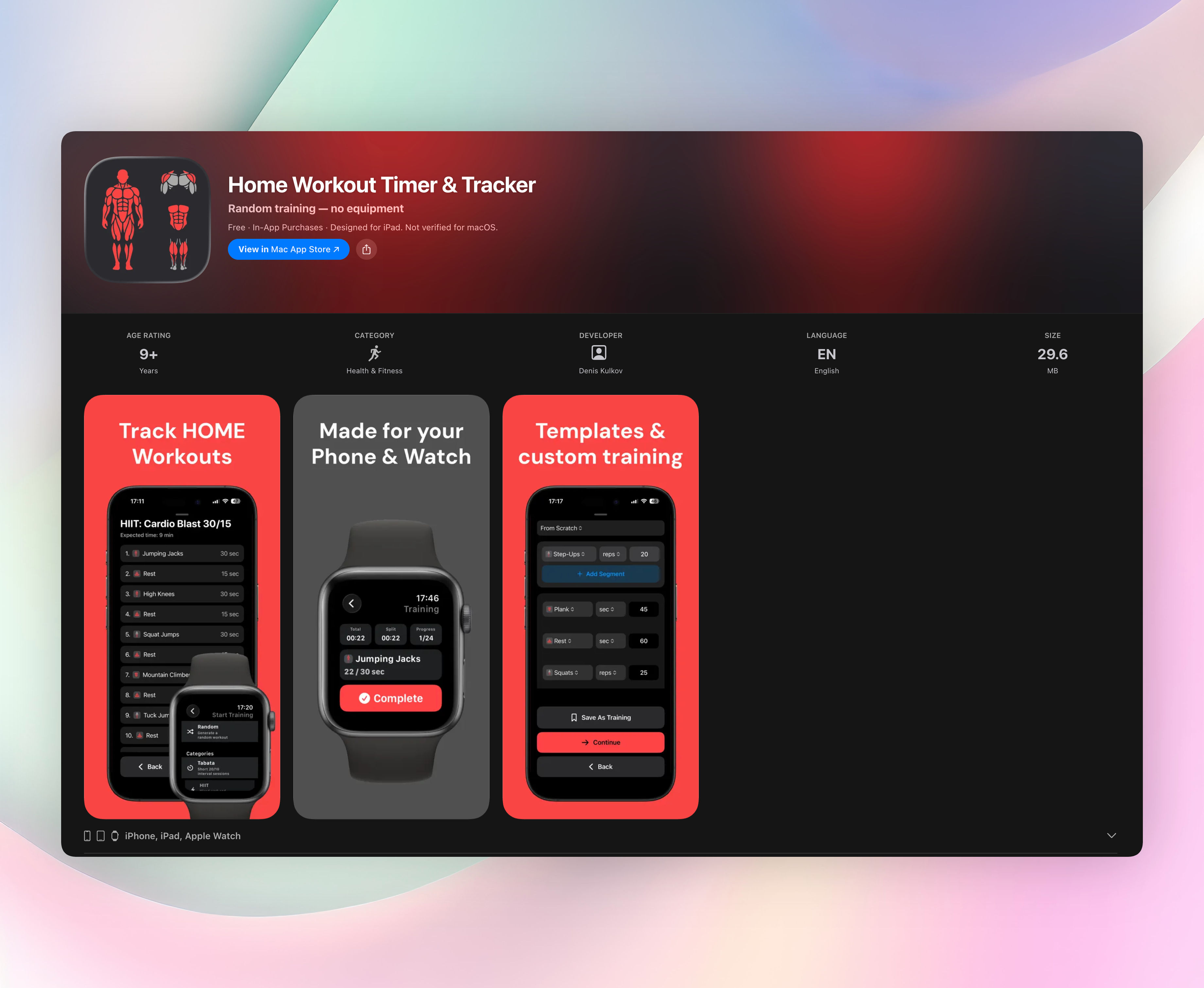
Getting the timing right matters more here than in most HIIT formats, because the entire point is holding a specific heart rate zone for a full four minutes, not eyeballing when to stop. Workout Timer is an interval timer and workout tracker for iPhone and Apple Watch with Tabata, HIIT, EMOM/AMRAP-style custom, Strength, Bodyweight, and Core templates, plus session history — setting a custom 4-minutes-on, 3-minutes-off interval and logging each 4x4 session takes the guesswork out of watching a stopwatch mid-run.
Norwegian 4x4 vs Other Interval Protocols
| Protocol | Work : Rest | Target Intensity | Total Work Time |
|---|---|---|---|
| Norwegian 4x4 | 4 min : 3 min, x4 | 85–95% max HR | 16 min |
| Tabata | 20 sec : 10 sec, x8 | All-out | ~2.7 min |
| 30/30s | 30 sec : 30 sec, x10–15 | 90–100% max HR | 5–7.5 min |
| Classic long intervals | 5–8 min : 2–3 min, x3–4 | 80–90% max HR | 15–32 min |
The short formats spend more time near maximal effort per second, but the intervals are too brief to actually hold heart rate near max. The 4x4 method sits in the middle: intervals long enough to reach and hold 85–95% of max heart rate, short enough to repeat four times with real quality in each one.
How Often to Train the 4x4 Method
One or two sessions a week is a practical starting range, spaced with easy or rest days between them — the work intervals are demanding enough on the cardiovascular system that back-to-back days tend to erode quality rather than build it. Track pace or power at a similar heart rate across several weeks. That is also how VO2 max training typically progresses: slow at first, then a noticeable jump once the adaptation catches up to the training load.
If you're not sure where your current fitness sits before starting, it's worth checking what a good VO2 max looks like for your age and sex first — it gives you a baseline to measure the 4x4 method's progress against, rather than training blind.
FAQ
How long is a Norwegian 4x4 workout?
About 40–45 minutes total: a 10-minute warm-up, four rounds of four minutes hard and three minutes easy (28 minutes), and a 5-minute cooldown.
Can I do the Norwegian 4x4 method on a bike or rowing machine?
Yes. The protocol isn't tied to running — cycling, rowing, and incline walking all work, since the heart rate targets are what matter, not the mode of exercise.
Is the Norwegian 4x4 protocol the same as HIIT?
It's a form of HIIT, but a longer-interval one. Compared with Tabata or 30-second sprint formats, the four-minute work intervals hold your heart rate near its max for longer, which is what drives VO2 max gains specifically.
What heart rate zone should I target during the hard intervals?
85–95% of max heart rate, ideally climbing into the top of that range by the third or fourth minute of each interval.
How many times a week should I do 4x4 interval training?
Two to three sessions a week, with an easy or rest day between them, is the standard frequency used in most 4x4 training programs.
Free VO2 Max Trainer tools
- Calisthenics Workout PlannerGenerate balanced push, pull, leg and core sessions with no equipment-heavy exercise list or signup.
- Cooper 12-Minute VO2 Max CalculatorEnter the distance you covered in 12 minutes. The calculator applies the Cooper field-test equation and shows an estimated VO2 max, average speed, and pace.
- Interval TimerRun work and rest rounds from your browser. Start from a Tabata, HIIT, EMOM, boxing or circuit preset, or set the prep, work, rest and round count yourself.
- Kettlebell Workout PlannerGet two to five balanced sessions using four movements and a time-scaled number of rounds.