What is Zone 2 training and how do you find it?
Zone 2 training is steady aerobic work below the first ventilatory or lactate threshold. In one common five-zone model it may sit near 60–70% of maximum heart rate, but zone systems differ; conversational effort is often the more useful field check. It's the aerobic base that interval and threshold work sit on top of.
What Is Zone 2 Training, Physiologically?
Endurance zone models split effort by how your body produces energy, not just how hard it feels. Zone 2 sits just below your first lactate (or ventilatory) threshold — the point where lactate starts building up faster than you can clear it. Below that line, your muscles lean on fat oxidation and slow-twitch fibers, breathing stays easy, and blood lactate remains relatively stable; a fixed 2 mmol/L cutoff does not fit everyone, which is why you can sustain zone 2 for an hour or more without digging into your recovery.
Exactly where "zone 2" falls depends on the system. In the common 5-zone heart-rate model, it spans roughly 60–70% of max heart rate. Cyclists using power-based zones define it relative to functional threshold power instead, and the percentage range looks different again — none of these numbers are wrong, they're measuring the same physiological state through different rulers. What matters is the marker underneath: easy enough to hold a conversation, hard enough that it isn't a stroll.
The training effect comes from repetition, not intensity. Time here drives mitochondrial density, capillary growth around muscle fibers, and a more efficient fat-burning system — adaptations that raise your aerobic ceiling and spare stored carbohydrate at any given pace. The adaptations accumulate through consistent training rather than one session.
Finding Your Zone 2 Heart Rate Without a Lab Test
A graded lab test with lactate or gas-exchange measurements can estimate the threshold more directly, though even laboratory thresholds depend on the protocol and definition used. Most people don't have one, so a few field methods get you close enough for productive zone 2 heart rate training with nothing more than a watch.
Heart rate reserve (Karvonen). Some five-zone plans place Zone 2 around 60–70% of heart-rate reserve: subtract resting heart rate from maximum, multiply by the chosen percentage, then add resting heart rate back in. It accounts for resting heart rate than a flat percentage of max alone. The catch is your max heart rate: the standard 220-minus-age formula can be off by 10–15 beats per minute either way, so treat the result as a starting point, not a fact.
The MAF method. Phil Maffetone's formula — 180 minus your age, with small adjustments for training history and health — gives a single target rather than a range. It runs conservative for a lot of trained athletes but is a reasonable starting point with no other data.
The talk test and nasal breathing. If you can speak in full sentences without gasping, you're at or below zone 2. A stricter version: breathe only through your nose at that pace — once you need your mouth to keep up, you've drifted into zone 3.
Perceived effort. Zone 2 should feel like a 3 or 4 out of 10, easy enough to hold for a long time, not an effort you're gritting through.
Heart rate drifts with heat, sleep debt, caffeine, and stress, so on a rough day your zone 2 pace can be noticeably slower for the same heart rate as usual. Cross-check two methods — heart rate plus the talk test — rather than trusting either alone.
Zone 2 vs. Zone 3 and Threshold Work
The "gray zone" — zone 3 — is where a lot of training time gets wasted. It feels productive because you're breathing hard and sweating, but it's too intense to build the aerobic base efficiently and not intense enough to meaningfully raise your threshold.
| Zone 2 | Zone 3 (gray zone) | Threshold (zone 4) | |
|---|---|---|---|
| Feel | Conversational, easy | Moderately hard, breathing up | Hard, sustainable ~20–60 min |
| Approx. % max HR | 60–70% | 70–80% | 80–90% |
| Primary fuel | Mostly fat | Mixed fat and carbohydrate | Mostly carbohydrate |
| Blood lactate | Low, stable (roughly <2 mmol/L) | Rising, not yet stable | Near where it starts to spike (~4 mmol/L) |
| Recovery cost | Very low — repeatable daily | Moderate, adds up fast | High — needs 24–48 hrs |
| Main adaptation | Mitochondria, capillaries, fat use | Little unique benefit | Raises the threshold itself |
Threshold work has its place — it's how you push your lactate threshold higher — but it's costly to recover from and only useful in limited doses. Zone 3 mostly just leaves you tired without building either the base or the ceiling.
Why Zone 2 Training Pairs With Interval Work
Most structured programs — cycling, running, home HIIT — end up "polarized": a large majority of volume at an easy, zone 2 effort, and a smaller slice spent genuinely hard, with little in between. That split isn't an accident. Hard sessions — something like Norwegian 4x4 intervals — push your ceiling upward and raise VO2 max over time. Zone 2 is what lets you show up to those sessions recovered enough to hit them hard, and it widens the base those intervals are built on.
The other draw of zone 2 heart rate training is practical: it's low-cost enough to repeat several times a week without eating into the recovery you need for intervals or strength work. A 45–75 minute session on an easy day doesn't compete with Tuesday's interval workout the way another hard session would.
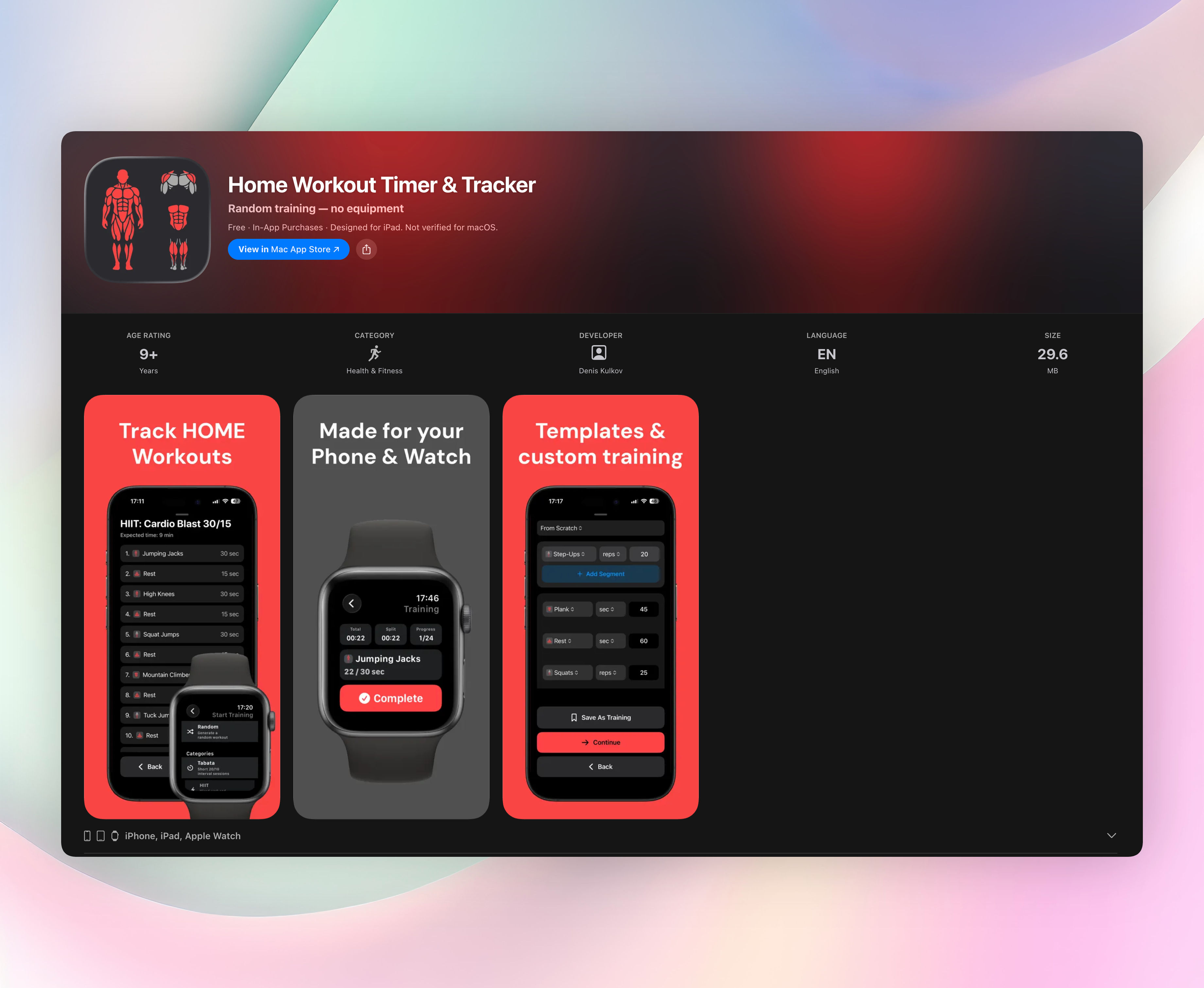
On easy days, a plain interval timer keeps you honest — start it, hold the effort, and don't check your watch every ninety seconds. Workout Timer is an interval timer and workout tracker for iPhone and Apple Watch with Tabata, HIIT, EMOM/AMRAP-style custom, Strength, Bodyweight, and Core templates, plus session history, so a steady zone 2 block and your next interval session end up logged in the same place.
FAQ
How long should a zone 2 session be?
Most programs use 30–90 minutes, with a longer session once or twice a week if your schedule allows it. Duration matters more than intensity — 45 easy minutes builds more aerobic base than 20 minutes at the same effort, since the adaptation depends on time spent at low intensity.
Can I do zone 2 training every day?
Yes — that's part of the point. It's low-impact enough on your nervous system and muscles that many endurance athletes train in zone 2 five or six days a week. Just watch total volume if you're also lifting or running intervals; the recovery cost is low, not zero.
Is walking zone 2 training?
For a deconditioned or older beginner, brisk walking can land squarely in the zone 2 heart rate range. For someone reasonably fit, walking often sits below the threshold entirely, so a light jog or easy bike ride is needed to reach the same heart rate.
How do I know if I'm in zone 3 instead of zone 2?
The clearest sign is breathing and speech — if you can't hold a full conversation or breathe comfortably through your nose, you've drifted into zone 3. Heart rate alone can lag behind effort, especially early in a session, so use the talk test as your real-time check.
Does zone 2 training build VO2 max?
Not directly — VO2 max responds mainly to intensity at or above your threshold, which is why interval work still matters. Zone 2 builds the mitochondrial and capillary base that makes those harder sessions more effective, so the two work together rather than substituting for each other.
Free VO2 Max Trainer tools
- Calisthenics Workout PlannerGenerate balanced push, pull, leg and core sessions with no equipment-heavy exercise list or signup.
- Cooper 12-Minute VO2 Max CalculatorEnter the distance you covered in 12 minutes. The calculator applies the Cooper field-test equation and shows an estimated VO2 max, average speed, and pace.
- Interval TimerRun work and rest rounds from your browser. Start from a Tabata, HIIT, EMOM, boxing or circuit preset, or set the prep, work, rest and round count yourself.
- Kettlebell Workout PlannerGet two to five balanced sessions using four movements and a time-scaled number of rounds.