How to pick work:rest ratios for your interval workout timer
Set your interval workout timer's ratio by matching effort to recovery: short, near-maximal efforts (20:10) need deep rest, longer moderate efforts (30:30, 40:20) need less. Beginners do best around 1:1 work:rest; conditioned athletes push toward 2:1 or higher.
What your work:rest ratio actually controls
A work:rest ratio isn't just a timer setting — it decides which energy system carries the workout and how completely you recover between rounds. Short work bouts under about 15 seconds draw mostly on stored phosphocreatine, which partially refills within 20 to 30 seconds of rest. Push the work interval past 30 seconds and you're leaning harder on anaerobic glycolysis, which increases fatigue and usually requires more recovery to preserve repeat quality. That's why a HIIT interval ratio built around a 20-second effort can get away with only 10 seconds of rest, while a 40-second effort usually needs closer to equal rest to hold quality across a full set.
The core HIIT ratios — 20:10, 30:30, 40:20, 1:1, and 2:1
Five numbers cover almost every home HIIT session worth running. Three are specific, named protocols; two are the general ratios those protocols represent.
| Protocol | Ratio | Work | Rest | Best suited to |
|---|---|---|---|---|
| Tabata-style | 2:1 | 20 sec | 10 sec | Well-conditioned athletes, short near-maximal bursts |
| Classic HIIT | 1:1 | 30 sec | 30 sec | Beginners and general conditioning work |
| Extended intervals | 2:1 | 40 sec | 20 sec | Athletes who hold pace for 6–10 rounds without fading |
| Even split | 1:1 | 40–60 sec | 40–60 sec | Building work capacity at moderate-hard intensity |
| Incomplete recovery | 3:1+ | 30–40 sec | 10–15 sec | Advanced athletes training lactate tolerance |
At 2:1, you're working twice as long as you rest, so quality drops off fast if the bout runs too long or the intensity is set too high — that's why 2:1 ratios pair best with either a very short bout (20:10) or a pace you already know you can hold (40:20). At 1:1, the recovery window matches the work, which is what makes 30:30 the standard starting ratio for anyone new to structured HIIT: demanding, but it doesn't fall apart by round four. Ratios beyond 2:1 stack incomplete recovery on top of incomplete recovery, training the ability to produce force while still fatigued — a real skill, but not one to chase before 1:1 and 2:1 work are solid.
Matching the ratio to your fitness level
There's no universally best HIIT interval ratio — the right one depends on your conditioning and what that session is for. If you're newer to interval training, judge yourself by consistency: hold a 30:30 session for six to eight rounds and check whether round six looks like round one. If your pace, reps, or power output drops noticeably, you don't need a harder ratio, you need more rest — back off toward 30:40 or even 20:30 until output stays level round to round.
If you're already conditioned and 1:1 feels too easy, that's the signal to test 40:20 or 20:10. The tell is heart rate recovery: if your breathing and output recover during the rest window and you can hit the same effort next round, you have room to shorten the rest further. If it doesn't recover and output craters after two or three rounds, the ratio is ahead of your conditioning — dial it back rather than gutting through it. Grinding through a ratio you're not ready for mostly trains poor pacing, not fitness.
Progressing your ratio over time
Start conservative no matter your general fitness level — even strong endurance athletes often find 20:10 rougher than expected the first time, since repeated near-maximal efforts stress the neuromuscular system differently than steady-state work does. Begin at 1:1 (30:30 is easiest to set up and remember), run it for two to three weeks, then progress by changing one variable at a time: shorten the rest (30:30 to 30:20), lengthen the work at the same ratio (30:30 to 40:40), or add rounds. Combining several changes at once is how sessions fall apart by round five.
Not every goal points toward shorter rest, either. Building toward sustained hard efforts, like the four-minute work intervals in Norwegian 4x4 training, usually means spending more time around 1:1 or even more generous ratios, since the goal is repeated high-quality output at a demanding but sustainable pace, not maximal fatigue each round. The same logic applies to your easy days — see our Zone 2 training guide for how they fit around HIIT rather than compete with it.
Setting your interval workout timer for each ratio
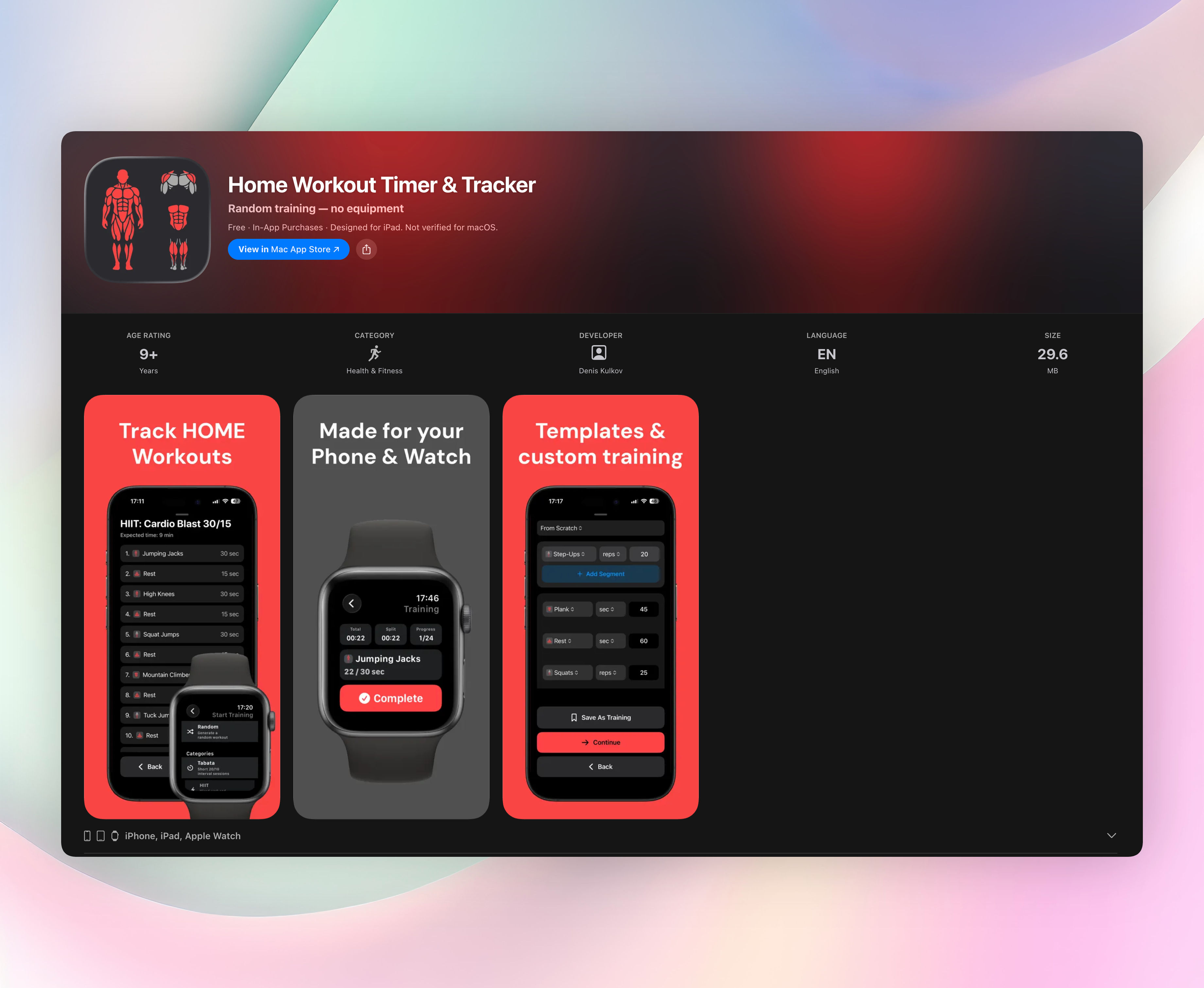
Once you've settled on a ratio, the hard part is running it consistently — round after round, without eyeballing a stopwatch or losing count. Workout Timer is an interval timer and workout tracker for iPhone and Apple Watch with Tabata, HIIT, EMOM/AMRAP-style custom, Strength, Bodyweight, and Core templates, plus session history, so you can program any of the ratios above once and reuse it every session.
FAQ
What is the best work to rest ratio for HIIT beginners?
A 1:1 ratio such as 30:30 is the safest starting point. It's demanding enough to build conditioning but forgiving enough that output won't collapse by the fourth or fifth round. Move to a 2:1 ratio like 40:20 only once 30:30 stops feeling challenging by round six.
Is 20:10 (Tabata) harder than 30:30?
Per round, yes — Tabata's 20:10 is a 2:1 ratio built around near-maximal effort, while 30:30 is a 1:1 ratio at a hard-but-sustainable pace. A full Tabata set is also much shorter, about four minutes for eight rounds, so the two protocols aren't directly comparable on total work done.
Can I use the same ratio for every HIIT workout?
You can, but it's not optimal. The same ratio can remain useful if pace, load, movement, or total volume changes, but progression should be deliberate. Rotating a 1:1 session with a 2:1 session, or progressively tightening the rest over several weeks, keeps the stimulus effective.
How many rounds should I do at each ratio?
Most home HIIT sessions run 6 to 10 rounds per ratio, or 15 to 20 minutes of total work-and-rest time including a warm-up. Shorter 2:1 ratios like 20:10 are traditionally done for 8 rounds, the original Tabata format, while 1:1 ratios like 30:30 tolerate more rounds because recovery is more complete.
Do I need the same work and rest every round, or can it change?
It can change — many structured sessions vary it on purpose, starting at 1:1 and tightening toward 2:1 as a finisher. What matters is that the ratio matches the effort you're actually producing that round, not that it stays fixed for the entire workout.
Free VO2 Max Trainer tools
- Calisthenics Workout PlannerGenerate balanced push, pull, leg and core sessions with no equipment-heavy exercise list or signup.
- Cooper 12-Minute VO2 Max CalculatorEnter the distance you covered in 12 minutes. The calculator applies the Cooper field-test equation and shows an estimated VO2 max, average speed, and pace.
- Interval TimerRun work and rest rounds from your browser. Start from a Tabata, HIIT, EMOM, boxing or circuit preset, or set the prep, work, rest and round count yourself.
- Kettlebell Workout PlannerGet two to five balanced sessions using four movements and a time-scaled number of rounds.