What is Tabata training and how does it work?
Tabata training is a high-intensity interval protocol: eight rounds of 20 seconds of all-out effort and 10 seconds of rest, four minutes total. Dr. Izumi Tabata developed it in the mid-1990s studying speed skaters in Tokyo. Done right, it's short and genuinely brutal.
What Is Tabata Training, Exactly?
Tabata is a specific 4-minute structure, not a general term for "short and hard." It's eight rounds of 20 seconds of maximum-intensity work followed by 10 seconds of rest, with the timing fixed round to round — no ramping up, no easing off.
The intensity target in the original research was roughly 170% of VO2 max — well beyond a pace you could hold for more than a few seconds, let alone four minutes straight.
The Origin of the Tabata Protocol
The tabata protocol comes from a 1996 study by Dr. Izumi Tabata, then a researcher at Japan's National Institute of Fitness and Sports in Tokyo.
Subjects were split into two groups: one did roughly an hour of moderate, steady-state cycling five days a week; the other did four minutes of intermittent high-intensity cycling, about 20 seconds on and 10 seconds off, at an output around 170% of VO2 max.
One detail gets lost in the popular version: in the original lab protocol, subjects worked to the point of exhaustion, which usually landed around seven or eight rounds, not a fixed eight every time.
How to Structure a Full Tabata Session
A full tabata workout is longer than the four-minute round itself. Structure it in three parts:
- Warm-up (5–8 minutes). Raise your heart rate and rehearse the movement pattern you're about to load — if round one is squat jumps, warm up with bodyweight squats and a few submaximal jumps first.
- The protocol (4 minutes). Eight rounds of 20 seconds all-out, 10 seconds rest.
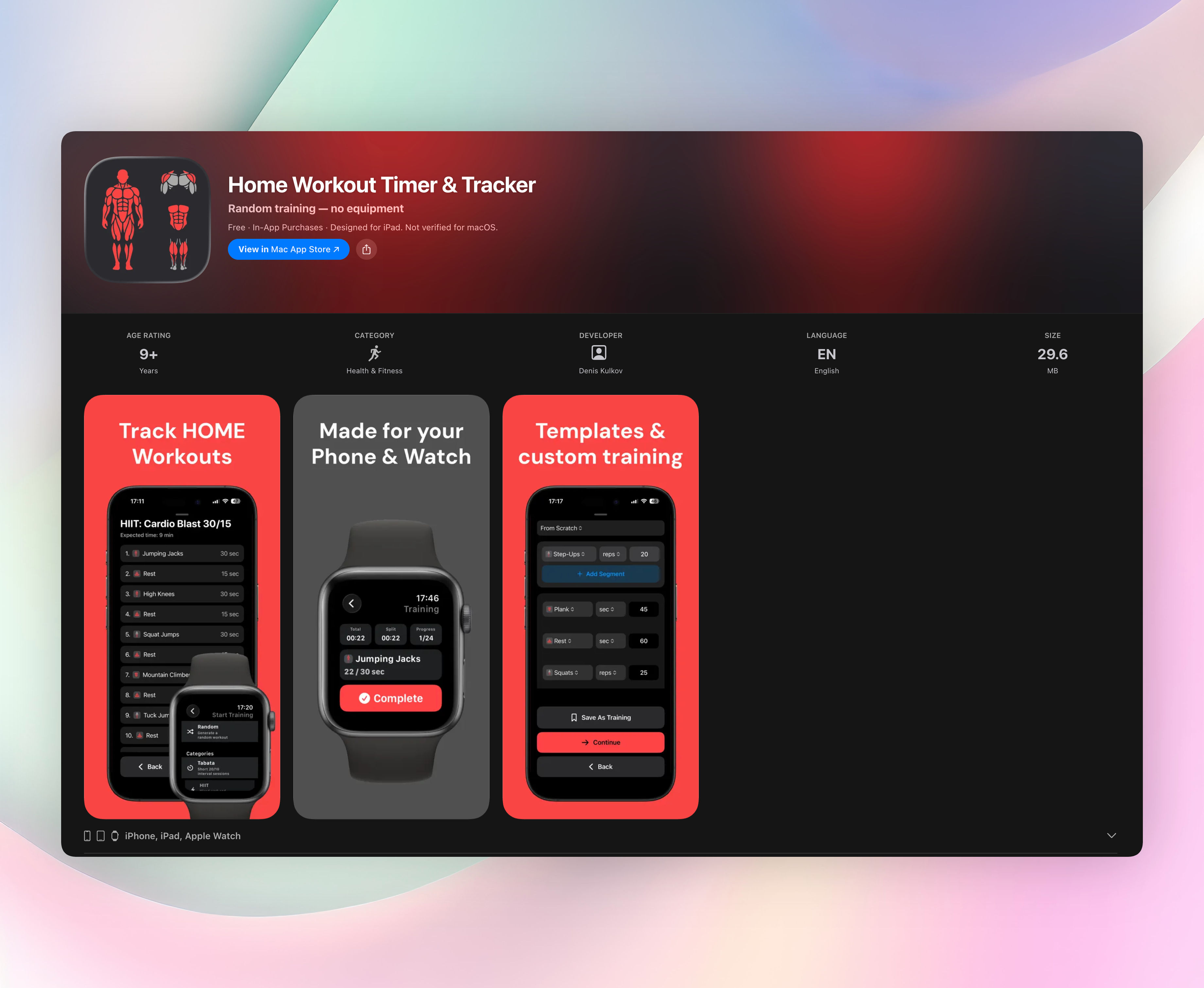
Because the windows are so short, you need something counting them for you — glancing at a phone clock mid-burpee costs seconds you don't have. A tabata timer that calls out "work" and "rest" out loud keeps your eyes on your form instead of a screen. Workout Timer is an interval timer and workout tracker for iPhone and Apple Watch with Tabata, HIIT, EMOM/AMRAP-style custom, Strength, Bodyweight, and Core templates, plus session history, so it handles the counting for you.
If you string more than one 4-minute block together — say, three rounds targeting different movements with a minute of rest between blocks — decide that rest period in advance too. Our guide to HIIT interval timer ratios covers work-to-rest math beyond the standard 2:1 tabata split.
Picking Exercises That Hold Up at Max Effort
The original research used a stationary bike, which is still the most faithful way to replicate the protocol — you can hit a genuinely maximal output without technical breakdown, since pedaling doesn't ask much of your coordination once you're gassed. Rowing machines work the same way.
For bodyweight tabata, the exercise has to survive fatigue without your form falling apart, because you're aiming for near-max effort in round one and still moving under control in round eight. Reliable options:
- Squat jumps or air squats
- Burpees (step-back burpees if a full burpee bothers your knees)
- Mountain climbers
- High knees or fast feet
- Kettlebell swings
- Jump rope
Avoid anything that demands fine motor control under fatigue — heavy barbell lifts, complex Olympic-lift variations, single-leg balance work. By round five or six you won't have the coordination to execute them safely at speed, and tabata's whole premise depends on maximal, unbroken effort in every 20-second window.
Tabata vs Other Interval Formats
Tabata is one specific ratio inside a much larger family of interval training. Here's how it stacks up against other formats you'll run into:
| Format | Work : Rest | Typical Length | Best For |
|---|---|---|---|
| Tabata | 20s : 10s (2:1) | 4 min per block | Max anaerobic + aerobic stimulus in minimal time |
| Standard HIIT circuit | 30–45s : 15–30s | 15–25 min | General conditioning, mixed exercises |
| EMOM | Work until the minute, rest the remainder | 10–20 min | Pacing and strength-endurance |
| Norwegian 4x4 | 4 min : 3 min | ~28 min | Building VO2 max over a training block |
If your main goal is raising VO2 max over weeks rather than surviving one brutal session, it's worth comparing tabata to longer-interval work. Our guide to Norwegian 4x4 training covers a format built specifically for that, and how to improve VO2 max lays out where tabata fits into a broader plan.
Common Mistakes That Blunt the Protocol
Going too easy on round one. This is the single most common error. Round one feels sustainable, so people pace it like they've got eight rounds to get through — but tabata only works if round one is close to an all-out sprint. If you finish round one thinking "I could've gone harder," you paced it wrong.
Treating the 10 seconds as recovery. It isn't — not real recovery. Ten seconds barely drops your heart rate. It's just enough to reset your positioning and grab one or two breaths before going again. If you're arriving at round two fully recovered, round one wasn't hard enough.
Choosing exercises you can't sustain at speed. Complex or heavily loaded movements break down by round four or five, which either slows your pace — defeating the point — or puts you at risk of injury as your form degrades under fatigue.
Running it too often. Four minutes doesn't sound like much, but true tabata-intensity work taxes your nervous system and joints. Two to three sessions a week, with a day between them, is a reasonable ceiling for most people; daily tabata is a fast way to end up overtrained or hurt.
Skipping the warm-up because the workout itself is short. A four-minute protocol doesn't mean a four-minute time commitment. Going into round one cold, without your heart rate and joints primed, is how people tweak a hamstring in round two.
FAQ
How long is a tabata workout?
The core protocol is exactly 4 minutes: eight rounds of 20 seconds of work and 10 seconds of rest. Add a 5–8 minute warm-up and a 5-minute cool-down, and a full session runs closer to 15–20 minutes, especially if you repeat the 4-minute block two or three times with rest between rounds of blocks.
Can beginners do tabata training?
Yes, but the intensity should scale, not the timing. A beginner still works at their own maximal effort for the full 20 seconds — that's relative to their fitness, not an absolute pace — using lower-impact versions of each move, like step-back burpees or air squats instead of jump squats, until conditioning catches up.
Is tabata better than regular HIIT?
Neither is strictly better; they train different things. Tabata's short, near-maximal bursts are efficient for building both aerobic and anaerobic capacity in very little time. A longer HIIT circuit at slightly lower intensity is easier to sustain and better suited to skill work or mixed-exercise conditioning.
How many calories does tabata burn?
This varies too much by body weight, exercise selection, and effort level to give a reliable number. Treat tabata as a conditioning and VO2 max tool first, not a calorie-burn strategy — a four-minute window is too short for total burn to be the main benefit.
Do I need equipment for tabata?
No. Bodyweight tabata — squat jumps, burpees, mountain climbers — is the most common home version and needs nothing but floor space. A stationary bike or rower gets you closest to the original research protocol if you have access to one.
Free VO2 Max Trainer tools
- Calisthenics Workout PlannerGenerate balanced push, pull, leg and core sessions with no equipment-heavy exercise list or signup.
- Cooper 12-Minute VO2 Max CalculatorEnter the distance you covered in 12 minutes. The calculator applies the Cooper field-test equation and shows an estimated VO2 max, average speed, and pace.
- Interval TimerRun work and rest rounds from your browser. Start from a Tabata, HIIT, EMOM, boxing or circuit preset, or set the prep, work, rest and round count yourself.
- Kettlebell Workout PlannerGet two to five balanced sessions using four movements and a time-scaled number of rounds.