What is AMRAP workout structure and how is it scored?
An AMRAP workout is a training format where you complete as many rounds or reps of a set exercise circuit as possible before a fixed time cap expires. Instead of counting sets, you race the clock. It's one of the simplest ways to measure work capacity.
What is AMRAP workout structure? Meaning and scoring
The amrap meaning is right in the acronym: as many rounds as possible, or as many reps as possible. You'll see both versions in programming. A multi-movement circuit ("AMRAP 12: 5 pull-ups, 10 push-ups, 15 squats") asks for rounds. A single-movement test ("AMRAP push-ups in 2 minutes") asks for reps.
Either way, the clock is fixed and the output is variable — the opposite of a workout where reps are fixed and time varies. That inversion is what makes AMRAP useful as a benchmark: pacing and fatigue management become part of the test, not just the exercises.
How an AMRAP is built
A typical AMRAP workout structure has three parts: a short list of exercises (two to five movements), a moderate rep count per movement (5–20 reps), and a time cap. You cycle through the movements in order, complete one full round, then go straight into the next without a prescribed rest. When the clock hits zero, you stop wherever you are.
Scoring reflects that "wherever you are." A finished AMRAP is logged as full rounds plus whatever reps you got into the next round — for example, "6 rounds + 8 reps." That partial-round tally is what separates two athletes with the same round count, so it's worth writing down as you go rather than reconstructing it after minute fifteen.
Setting a Time Cap
The cap you choose changes what the workout tests. A short cap — 5 to 8 minutes — favors intensity: heavier loads, harder skills, near-sprint pacing, since fatigue doesn't have time to compound. A moderate cap — 10 to 15 minutes — is the most common choice for general conditioning; long enough to demand real pacing, short enough that technique holds up. A long cap — 20 minutes or more — shifts the test toward aerobic capacity and pacing discipline over raw power, closer to steady endurance work than a sprint. If that aerobic base is the actual goal, improving your VO2 max with longer steady efforts pairs well with what a 20-plus-minute AMRAP trains.
When you're picking a cap for movements or loads you haven't tested before, round down. It's easier to add a round in the last minute than to bail out of a cap that was set too long.
AMRAP vs EMOM
AMRAP and EMOM both run off a clock, and both get filed under "interval training," but they test different things.
| AMRAP | EMOM | |
|---|---|---|
| Clock counts | Total rounds/reps within one time cap | A fresh interval (usually 60 seconds) that repeats |
| Rest | None built in — you go until the cap ends | Whatever's left in the interval after the set reps are done |
| What's scored | Rounds plus reps completed | Whether you hit each interval on time |
| Pacing goal | Maximize total output over the whole block | Hold a consistent, repeatable pace every interval |
| Best suited to | Testing work capacity, benchmark workouts | Skill practice, controlled intensity, strength-endurance |
The practical difference is how fatigue behaves. In an AMRAP, fatigue accumulates continuously and you manage it by slowing down or breaking reps into smaller sets. In an EMOM, fatigue resets somewhat every interval, since the clock forces a pause once you finish the prescribed reps — see our EMOM workout guide for how that structure is built. Choosing between the two comes down to whether you want continuous accumulated fatigue (AMRAP) or repeated short efforts with a guaranteed recovery window (EMOM).
Scaling an AMRAP
Because the round count is the score, scaling should protect your form, not your ego. Reduce reps per movement before you cut movements entirely — dropping from 15 squats to 10 keeps the circuit's character intact. Swap a skill move you can't yet do safely under fatigue, like strict pull-ups, for a strength-equivalent you can do at higher volume, like ring rows. If a movement is loaded, drop the weight before you drop the time cap — a lighter load held for the full duration teaches pacing better than a heavy load you can only survive for half the workout.
Running the Clock
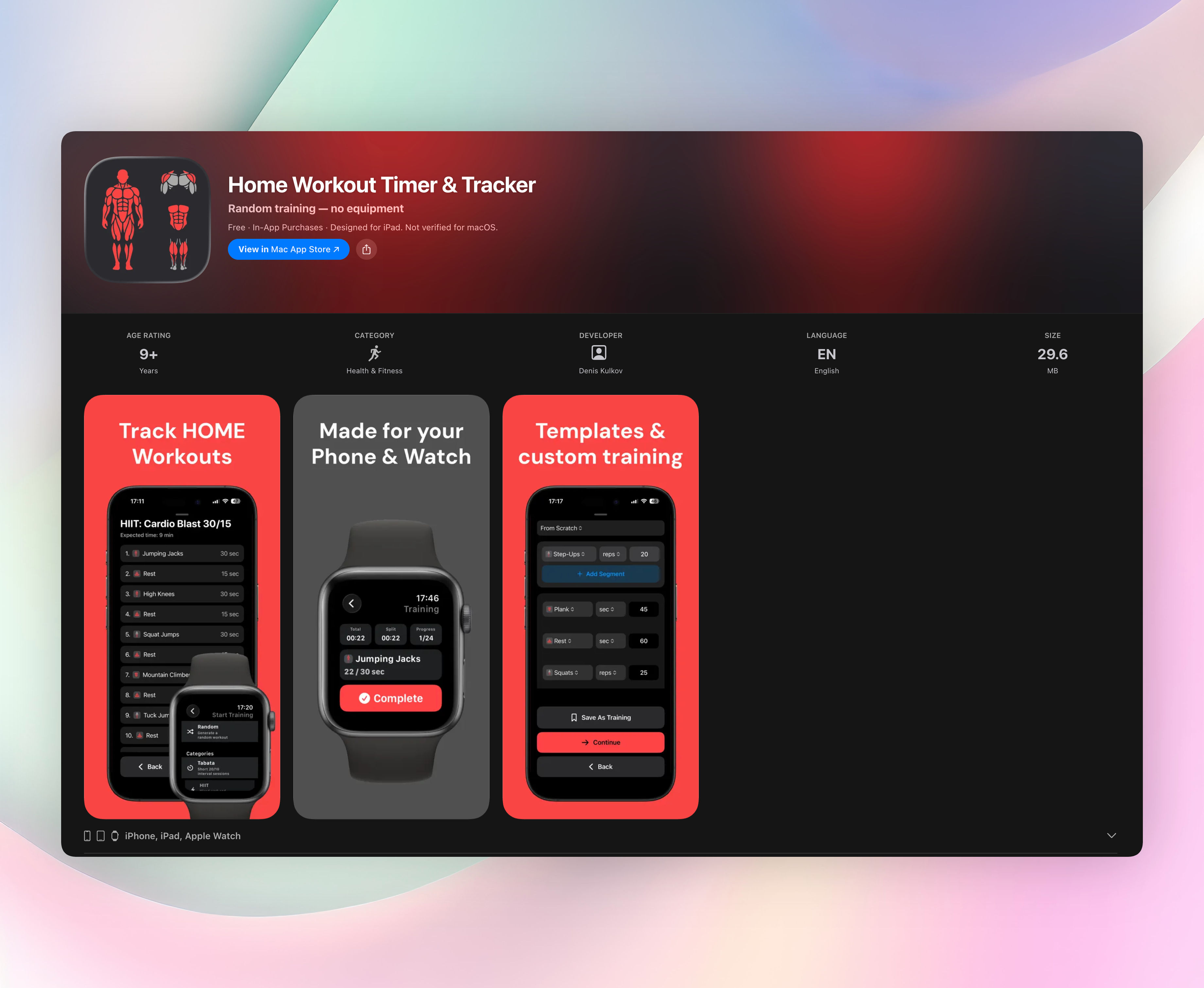
Counting rounds while watching a timer is where most AMRAPs fall apart, especially past the ten-minute mark when round and rep counts start to blur. Workout Timer is an interval timer and workout tracker for iPhone and Apple Watch with Tabata, HIIT, EMOM/AMRAP-style custom, Strength, Bodyweight, and Core templates, plus a session history you can check to see whether your round count is actually climbing week to week.
FAQ
Is an AMRAP workout good for beginners?
Yes, as long as the exercises and reps are scaled to something sustainable for the full cap. Start with a shorter cap, 5 to 8 minutes, and simpler movements, then extend it once you can hold a steady pace for the whole round.
How many rounds should I aim for in an AMRAP?
There's no universal target — it depends on the movements, reps per round, and your fitness level. A better goal than a round count is even pacing: your splits in minute 2 and minute 10 shouldn't be wildly different.
What does AMRAP mean in weightlifting versus CrossFit?
In CrossFit and general conditioning, AMRAP almost always means a timed circuit scored in rounds and reps. In strength programs, you'll sometimes see an "AMRAP set" attached to a single lift — as many reps as possible at a given weight, no circuit involved.
Can you do an AMRAP with just bodyweight exercises?
Yes. Bodyweight AMRAPs built from push-ups, squats, lunges, burpees, and plank holds are common precisely because they need no equipment and scale easily by adjusting reps or tempo.
How is an AMRAP scored?
As full rounds completed plus any extra reps finished before time expired, written as "rounds + reps" — for example, 7 rounds + 4 reps. Comparing two scores with the same exercises and cap, more rounds always wins; if rounds tie, more reps in the partial round wins.
Free VO2 Max Trainer tools
- Calisthenics Workout PlannerGenerate balanced push, pull, leg and core sessions with no equipment-heavy exercise list or signup.
- Cooper 12-Minute VO2 Max CalculatorEnter the distance you covered in 12 minutes. The calculator applies the Cooper field-test equation and shows an estimated VO2 max, average speed, and pace.
- Interval TimerRun work and rest rounds from your browser. Start from a Tabata, HIIT, EMOM, boxing or circuit preset, or set the prep, work, rest and round count yourself.
- Kettlebell Workout PlannerGet two to five balanced sessions using four movements and a time-scaled number of rounds.