What is EMOM workout structure and how does it work?
What is EMOM workout structure? Every Minute On the Minute programming asks you to complete a set amount of work at the start of every 60-second interval, then rest with whatever time is left before the next minute starts. That's the whole structure: constant effort, built-in recovery.
What is EMOM workout structure, exactly?
The EMOM meaning is exactly what the acronym spells out: every minute, on the minute, you start a fresh round of work. You pick an exercise (or a short couplet of exercises) and a target number of reps, then perform that work as soon as the clock rolls over to a new minute. Finish in 25 seconds and you banked 35 seconds of rest. Finish in 50 seconds and you got 10. The clock never pauses between rounds, which is what separates an EMOM from a fixed interval like Tabata, where work and rest are both locked in place regardless of how you perform.
EMOMs are common in CrossFit and strength-and-conditioning programs. Strength coaches use it for density work (a heavy triple every minute for 8–10 rounds), conditioning coaches use it for repeat-effort cardio (burpees, kettlebell swings, rowing calories), and plenty of programs mix the two within a single session.
How an EMOM Workout Structure Works Minute by Minute
The basic EMOM workout structure has three variables: total duration, the movement(s) assigned, and the rep target per minute. A simple version runs 10 straight minutes of one movement — say, 12 kettlebell swings every minute on the minute. An alternating version splits the work across two or more movements: odd minutes are 10 burpees, even minutes are 15 air squats, repeated for 16 total minutes.
Duration is usually 8 to 20 minutes for a single EMOM block. Shorter blocks let you push closer to your ceiling each round; longer blocks force you to pace, because the same rep scheme that felt easy in minute 2 gets considerably harder by minute 14. That's the core skill an EMOM actually trains — picking a number you can repeat, not just hit once.
Building Your Own EMOM
Start with a total time (10–16 minutes is a solid default), then choose one to three movements you can perform with good form even when tired. Set a rep count or load that leaves genuine rest — as a rule of thumb, your work should take somewhere between 60% and 75% of the minute for most conditioning EMOMs, and less than that for strength work where you're moving real weight.
Once you've got the basic structure down, adapting it for different goals is mostly a matter of what fills the minute: heavier loads and lower reps for strength, moderate loads and higher reps for conditioning, or a skill movement (double-unders, pull-ups) paired with an easy movement to let you practice technique under mild fatigue.
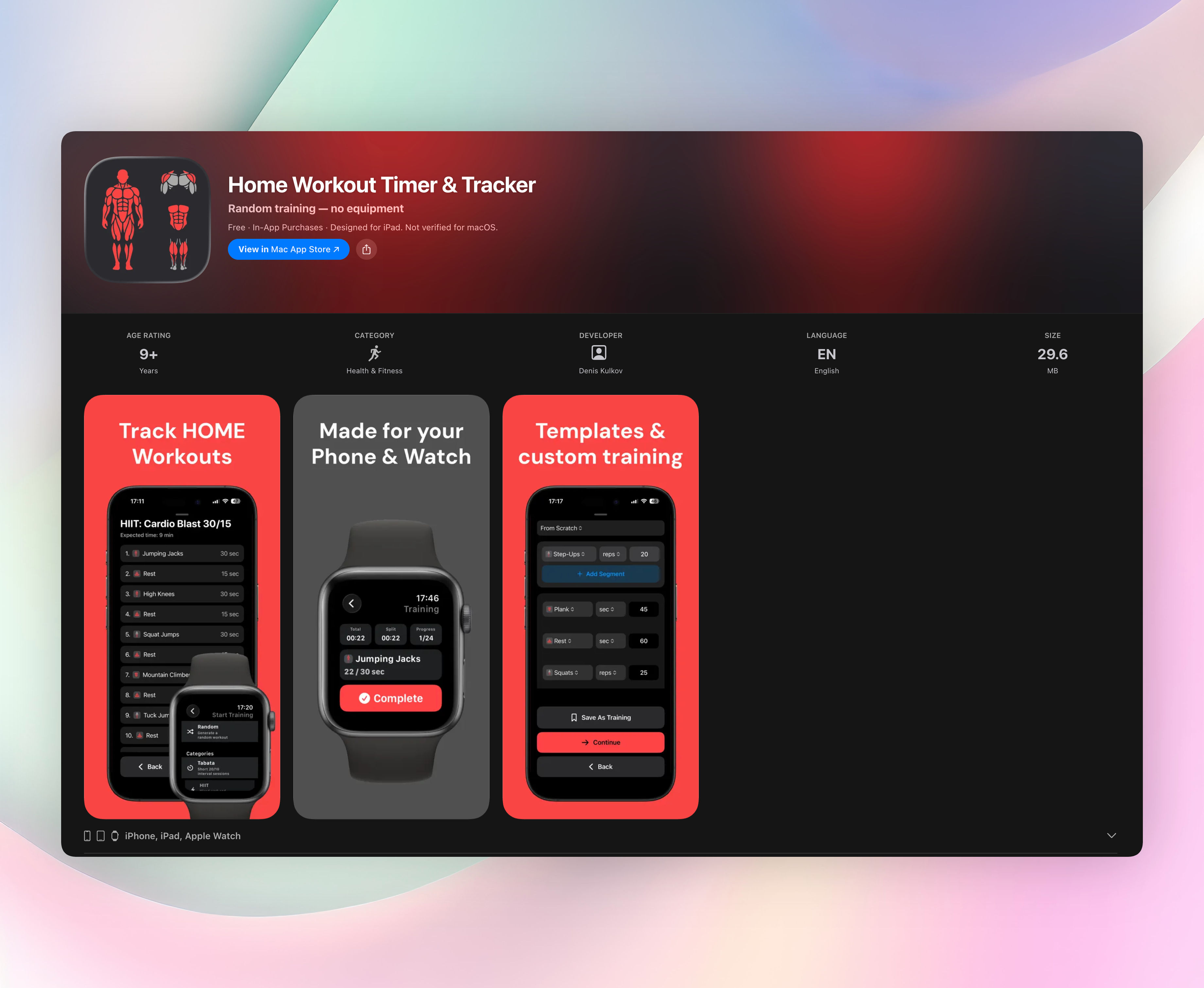
Cueing each new minute yourself gets old fast once you're breathing hard around round six. Workout Timer is an interval timer and workout tracker for iPhone and Apple Watch with Tabata, HIIT, EMOM/AMRAP-style custom, Strength, Bodyweight and Core templates, plus session history, so it can call each new minute for you while you count reps instead of watching the clock.
Scaling the Work So Rest Stays Meaningful
The most common EMOM mistake is picking a rep target based on your best round instead of your worst. Ten burpees might take 25 seconds fresh and 50 seconds by round 8 — if you set the rep count off that first, easy minute, you'll spend the back half of the workout with no rest at all, which turns a structured interval session into an uncontrolled grind. Reference your work-to-rest ratios against your slowest expected round, not your fastest.
For strength EMOMs, the same logic applies to load. A set you could grind out for 5 reps once is not the same as a set you can repeat cleanly across 10 rounds with only 45–50 seconds between them; leave one or two reps in reserve on the working weight so bar speed and position hold up in round 9 the way they did in round 1.
For pure conditioning, the value of an EMOM over something like zone 2 work is the repeated, controlled effort against a fixed clock. That only works if rest actually shows up every round — even 15 seconds is enough to reset breathing and keep form honest, but zero seconds turns the format into an unbroken AMRAP instead.
EMOM vs. AMRAP vs. Tabata
| Format | Work/rest pattern | Rest | Best for |
|---|---|---|---|
| EMOM | New round every 60 sec | Whatever's left after the work | Repeatable strength or conditioning under mild, controlled fatigue |
| AMRAP | Continuous work for a fixed total time | None until the time cap | Testing total output and pacing over a set duration |
| Tabata | 20 sec work, 10 sec rest, fixed | Fixed 10 sec | Short, maximal-intensity conditioning bouts |
FAQ
How long should an EMOM workout be?
Most EMOMs run 8 to 20 minutes. Beginners tend to do better starting around 10 minutes with one or two movements, since pacing and rest management take a few sessions to learn before you can hold quality across a longer block.
What's a good beginner EMOM?
A simple starting structure is 10 minutes: even minutes do 10 goblet squats, odd minutes do 8 push-ups, scaled to whatever rep count leaves you at least 15–20 seconds of rest each round. Add reps or swap in a harder progression only once that rest cushion has been consistent for a couple of sessions.
Can you do EMOM every day?
You can, but it depends what's in the minute. A light, technique-focused EMOM can be done frequently, while an EMOM built around heavy strength work or high-output conditioning needs the same recovery between sessions as any other hard training day — frequency should reflect the movements, load, and the rest of the week.
Is EMOM good for building strength, or is it just cardio?
Both, depending on the rep scheme and load. Low reps at a heavy weight (2–5 reps every minute) trains strength and bar speed under accumulating fatigue; higher reps at bodyweight or light load shifts the same structure toward conditioning. The clock doesn't care which — it's the loading that decides.
Free VO2 Max Trainer tools
- Calisthenics Workout PlannerGenerate balanced push, pull, leg and core sessions with no equipment-heavy exercise list or signup.
- Cooper 12-Minute VO2 Max CalculatorEnter the distance you covered in 12 minutes. The calculator applies the Cooper field-test equation and shows an estimated VO2 max, average speed, and pace.
- Interval TimerRun work and rest rounds from your browser. Start from a Tabata, HIIT, EMOM, boxing or circuit preset, or set the prep, work, rest and round count yourself.
- Kettlebell Workout PlannerGet two to five balanced sessions using four movements and a time-scaled number of rounds.